Most customer interviews go like this: the founder describes the idea, the person nods, says "that sounds really useful", maybe adds "I'd definitely use that", and the founder leaves feeling validated. Three months later, launch day arrives and almost nobody signs up.
The person wasn't lying, exactly. They were being kind. Ask people about a hypothetical future and they'll tell you what you want to hear. Ask them about what they did last week and you'll hear the truth.
Three ground rules before you start
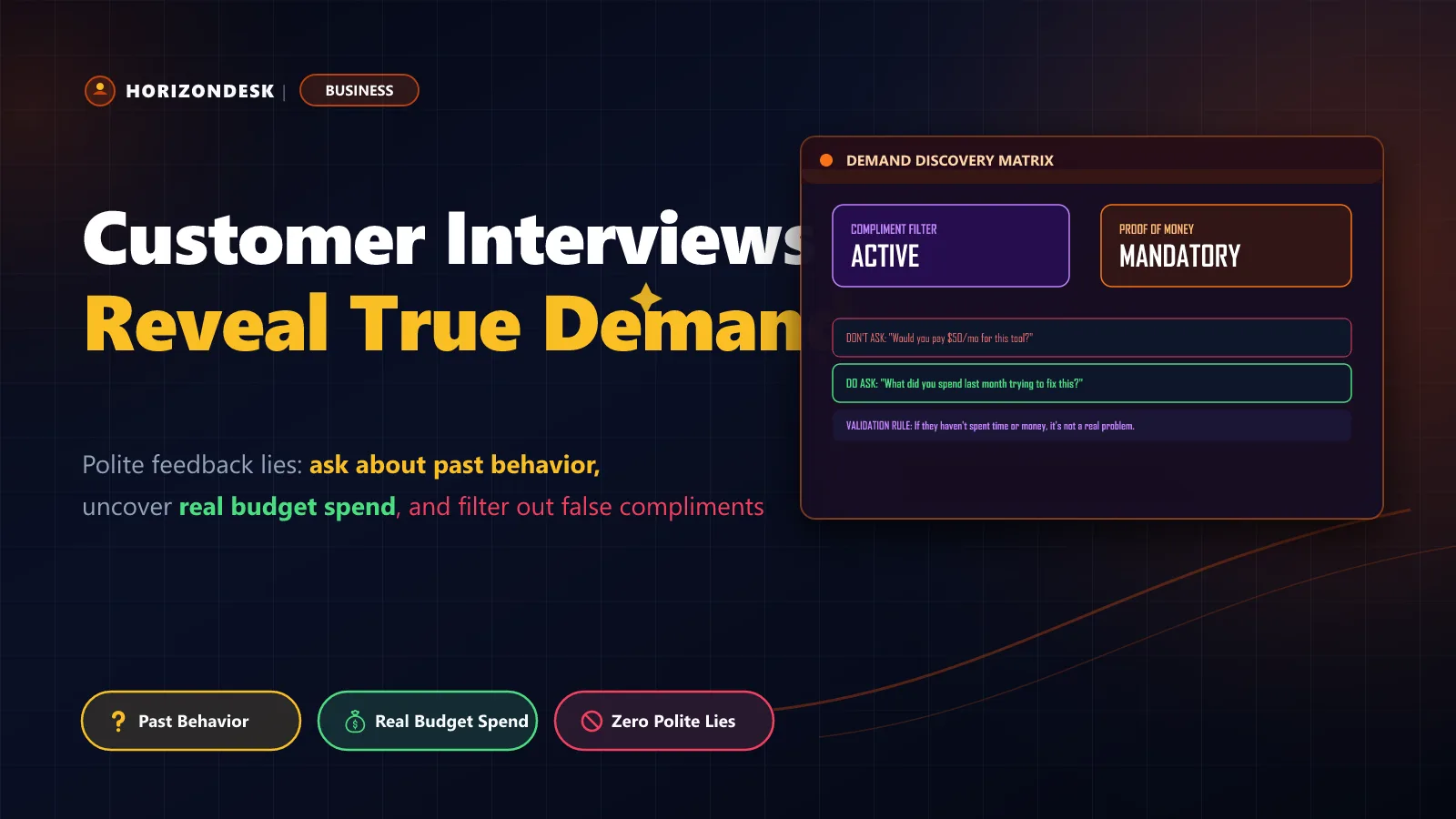
- Ask about the past, not the future. "Would you use..." and "Would you pay for..." produce opinions. "When did you last..." produces facts.
- Don't pitch. The moment you describe your idea, the interview becomes about protecting your feelings. Save the product for the end, if at all.
- Listen far more than you talk. Aim for the other person speaking at least 80% of the time. Silence is a tool; people fill it with the details you need.
The five questions
1. "Tell me about the last time you [did the task]."
Anchor everything in a specific, recent event. If you're building invoicing software for freelancers, ask about the last invoice they sent: when, to whom, how long it took, what tools they used. Specific stories are much harder to embellish than general opinions, and they reveal the real workflow rather than the idealised one.
2. "What was the hardest part of that?"
Let them name the pain in their own words. Often it won't be the problem you assumed. You might be focused on creating invoices when the real headache is chasing clients who pay late.
3. "Why was that hard?"
Ask "why" at least twice. The first answer is usually a symptom; the second or third gets to the cause. "Chasing payments is awkward" might really be "I'm worried that reminding a big client will cost me future work" — a very different problem to solve.
4. "What have you tried to fix it?"
This is the single most revealing question. If someone has a painful problem, they've already tried something: a spreadsheet, a template, an assistant, a competing product. If they've tried nothing, the problem probably isn't painful enough to buy a solution for.
5. "What did that cost you — in money or time?"
This is your willingness-to-pay signal. Someone spending ₹5,000 a month on a part-time assistant or $200 a month on a patchwork of tools has a budget you can compete for. Someone who "just deals with it" may never pay.
Compliments are not data. Past behaviour is.
Telling signal from noise
After a few interviews, sort what you've heard into strong and weak evidence:
| Strong signal | Weak signal |
|---|---|
| They describe a recent, specific incident in detail | "Yeah, that's sometimes annoying" |
| They've built a workaround or paid for a tool | "I'd definitely use something like that" |
| They ask when they can try it | "Sounds cool, keep me posted" |
| They introduce you to a colleague with the same problem | Generic praise for the idea |
| They agree to a paid pilot or pre-order | A promise to sign up "when it launches" |
After the interview
Write up your notes within an hour, while details are fresh. Record exact quotes where you can; they're invaluable later when writing landing pages and pitch decks. Tag each interview with the problems mentioned, the workarounds used and any money already being spent.
Patterns usually start to appear after ten to fifteen conversations. If the same pain, described in similar words, comes up again and again among people already spending money on it, you've found something worth building. If every interview tells a different story, that's useful too — it means you haven't found your customer yet, and it's far cheaper to learn that now than after launch.