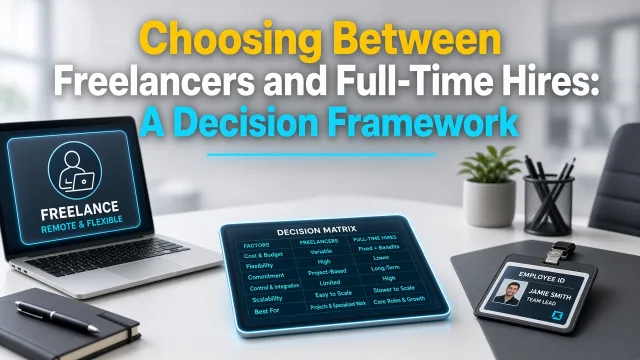
The freelancer-versus-full-time-hire question usually gets reduced to a cost comparison, which is the wrong starting point. A freelancer's hourly rate often looks more expensive than a salary divided into hours, but that comparison ignores recruiting cost, management overhead, benefits, and the ramp-up time a full-time hire needs before becoming productive. The better question is not which option costs less, but which structure actually fits the shape of the work.
The Real Question Is Not Cost
Two questions matter more than price: how long will this need exist, and how much company-specific context does the work require? A task that is finite, well-defined, and does not depend heavily on deep knowledge of the business is usually a good fit for a freelancer or contractor. A role that is ongoing, requires judgment calls tied to company strategy, or needs the person to build relationships across the team points toward a full-time hire.
What Freelancers Are Good For
Freelancers and contractors are well suited to work with a clear deliverable and a defined scope: a website redesign, a specific marketing campaign, a one-time financial audit, or specialized technical work outside the team's existing skill set. They can usually start faster than a full-time hire, since there is no lengthy recruiting process, and they can be scaled up or down as needs change without the complexity of hiring and firing.
The tradeoff is availability and depth of context. A freelancer working across multiple clients will rarely have the same bandwidth for urgent requests, and will not accumulate the same institutional knowledge over time that a full-time employee does.
What Full-Time Hires Are Good For
Full-time hires make sense when the work is ongoing, when it requires building relationships with customers or teammates over time, or when the role involves judgment calls that depend on deep familiarity with the company's history and priorities. They also make sense when the volume of work is consistent enough to justify dedicated capacity, rather than work that comes in bursts.
The cost of a full-time hire extends beyond salary: recruiting time, onboarding, benefits, equipment, and management attention all add real cost that is easy to underestimate when comparing a salary figure to a freelancer's invoice.
A Simple Framework for Deciding
| Factor | Favors Freelancer | Favors Full-Time Hire |
|---|---|---|
| Duration of need | Short-term or project-based | Ongoing, indefinite |
| Context required | Low, mostly self-contained work | High, needs company knowledge |
| Volume of work | Inconsistent or bursty | Steady, predictable |
| Specialization | Niche skill used occasionally | Core skill used constantly |
| Speed to start | Fast, minimal process | Slower, requires recruiting |
Most roles will lean clearly toward one column. The harder cases are the ones that sit in the middle, where a hybrid approach is often the better answer.
The Hybrid Approach Most Companies Land On
Many small companies end up using both: a lean full-time team covering the ongoing, context-heavy work, supplemented by freelancers or contractors for specialized or overflow work. This keeps fixed costs lower while still building institutional knowledge where it matters most. A common pattern is to start a function with a freelancer to validate that the work is needed at all, then convert it to a full-time role once the volume and consistency justify it.
Next Steps
List the roles currently open or under consideration, and sort each one using the duration, context, volume, and specialization factors above. For anything in the middle ground, consider a trial period with a freelancer or contractor before committing to a full-time hire, and revisit the decision once there is real data on how the work actually behaves.