Where ancient Rome still stands
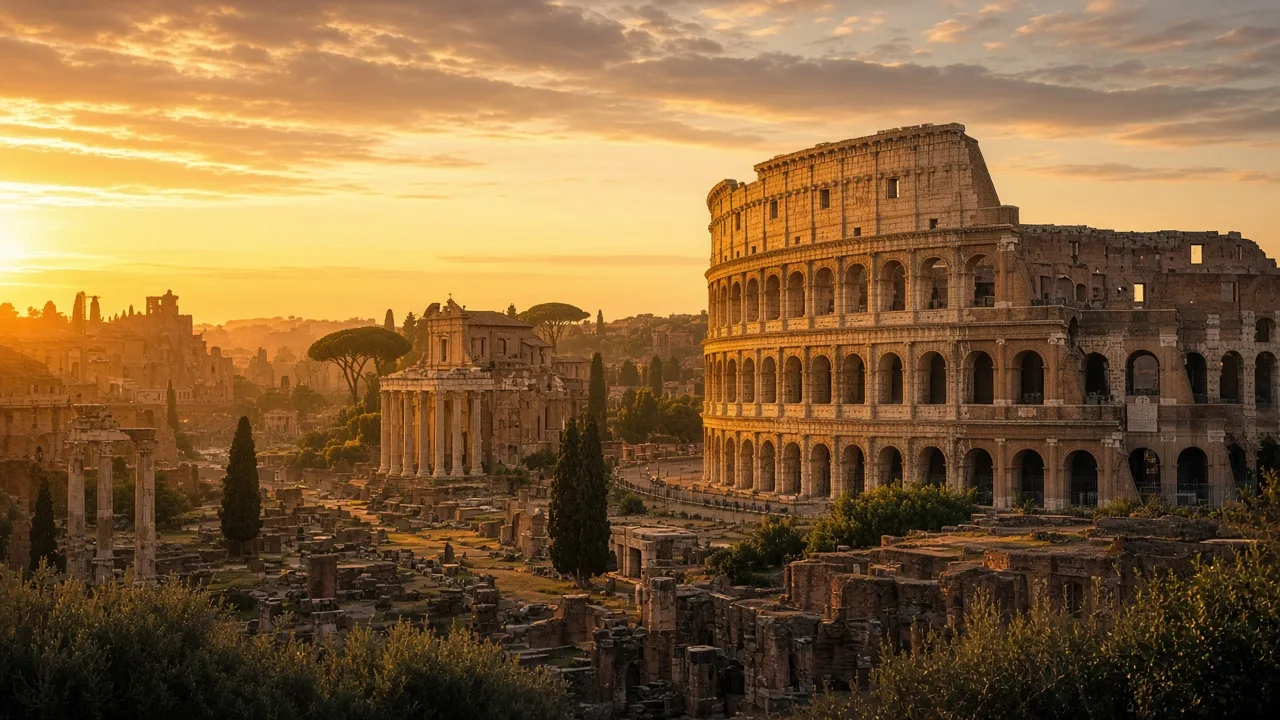
Step out of the Colosseo metro station and the great amphitheatre fills your view, scarred, enormous and somehow still alive. Beside it, the Roman Forum and the Palatine Hill hold the ruins of temples, law courts and imperial palaces that once ran an empire. Together they form the heart of the Historic Centre of Rome, a UNESCO World Heritage Site first inscribed in 1980, and they are managed today by the Parco archeologico del Colosseo (Colosseum Archaeological Park).
A short history
The Colosseum, originally the Flavian Amphitheatre, was begun under Emperor Vespasian around 70 to 72 CE on the site of Nero's private lake and inaugurated by his son Titus in 80 CE with games said to have lasted 100 days. It could hold an estimated 50,000 or more spectators, who watched gladiator fights, animal hunts and public spectacles. A canvas awning shaded the crowd, and a complex underground (the hypogeum) of passages and lifts brought animals and fighters into the arena. Earthquakes, fires and centuries of stone-quarrying stripped it back to the shell we see today.
The Roman Forum, in the valley next door, was the political, religious and commercial centre of the city for centuries, lined with temples, basilicas and triumphal arches. Above it rises the Palatine Hill, linked by legend to Romulus and the founding of Rome, where emperors later built their palaces. Our word "palace" comes from Palatine.
What to see
- Colosseum first and second levels: Included in the standard ticket, with views over the arena and the underground, plus the Colosseum museum displays.
- The arena floor and underground: Available only with specific timed tickets. Standing in the reconstructed arena or walking the hypogeum gives a powerful sense of scale.
- The attic and panoramic lift: The upper levels, when open, offer a view across to the Forum and the Palatine.
- Arch of Constantine: The triumphal arch right outside the Colosseum, free to see.
- Roman Forum: The Via Sacra, the Arch of Titus, the Temple of Saturn, the Curia Julia (Senate House), the House of the Vestal Virgins and the Temple of Antoninus and Faustina.
- Palatine Hill: The Domus Flavia and Domus Augustana palaces, the stadium, the Farnese Gardens and the terrace view over the Circus Maximus. Some areas, such as the House of Augustus, have restricted opening days.
- Domus Aurea: Nero's Golden House, nearby, visited on separately booked guided tours.
Best time to visit
Spring (April to early June) and autumn (September to October) offer the best balance of pleasant weather and long days, though they are busy. July and August are hot and crowded, so visit at opening time or late afternoon. November to February is quieter and cooler, with shorter opening hours. The park participates in free first-Sunday-of-the-month entry, but expect long queues for tickets collected on the day.
How to get there from India
- Flights: Rome's main airport is Fiumicino (Leonardo da Vinci). Direct flights between India and Rome have operated from Delhi at times, but most travellers from Delhi, Mumbai, Bengaluru, Chennai, Hyderabad and Kolkata connect via Gulf or European hubs. Check current schedules, as routes change.
- Airport to the city: The Leonardo Express train runs from Fiumicino to Roma Termini in about 30 minutes; taxis have a fixed fare to the historic centre.
- To the Colosseum: Take Metro Line B to Colosseo station. Many central hotels are within walking distance, and buses and trams stop nearby.
Tickets for Indian travellers
Book through the park's official site, ticketing.colosseo.it. A timed Colosseum entry slot is compulsory. At the time of writing:
- Colosseum, Roman Forum and Palatine: about €18, valid 24 hours, with one entry to the Colosseum's first and second levels (no arena) and one entry to the Forum-Palatine area.
- Full Experience tickets (Arena, Underground and Arena, or Attic): about €24, valid for two consecutive days, with a limited stay inside the Colosseum.
- Forum Pass SUPER: Forum, Palatine and Imperial Fora without the Colosseum.
Reduced fares are mainly for EU citizens aged 18 to 24, so most Indian adults pay full price; children under 18 have generally entered free. Online sales usually open up to 30 days in advance, and the best slots sell out early. All prices and rules are approximate; check the official site before travel.
Visa notes for Indian passport holders
Indian citizens need a Schengen short-stay visa (type C) to visit Italy for tourism. Applications in India are submitted through VFS Global centres for the Italian embassy and consulates. The official visa fee for adults has been about €90 (around €45 for children aged 6 to 12), plus a separate VFS service charge, and the rupee amount changes with exchange rates. Apply through the country where you will spend the most time, and allow several weeks, as appointments can be scarce in peak season. Expect to provide flight and hotel bookings, travel insurance, bank statements and a cover letter. Rules are approximate and can change; check the Italian Embassy in New Delhi and VFS Global before applying.
Practical tips
- Give the Colosseum, Forum and Palatine a full day, or split them across two with a Full Experience ticket.
- Carry your passport or ID, as ticket names may be checked.
- Expect airport-style security; large bags are not allowed.
- The Forum and Palatine have little shade. Carry water, refill at the public "nasoni" fountains and wear comfortable shoes for uneven stones.
- Avoid unofficial ticket sellers outside the monument.
- Watch for pickpockets on Metro Line B and around the piazza.
- Return at dusk to see the Colosseum lit up from the Via dei Fori Imperiali.
Sources
- UNESCO World Heritage Centre: Historic Centre of Rome
- Parco archeologico del Colosseo: Opening Times and Tickets
- Parco archeologico del Colosseo: Colosseum, Roman Forum and Palatine ticket
- Parco archeologico del Colosseo: Full Experience Underground and Arena
- Embassy of Italy, New Delhi: Visas
- European Commission: Applying for a Schengen visa