Two cave complexes, fifteen centuries of art
A couple of hours apart in Maharashtra's Chhatrapati Sambhajinagar district (formerly Aurangabad), the Ajanta and Ellora Caves are among the greatest achievements of rock-cut architecture anywhere. Both were inscribed as UNESCO World Heritage Sites in 1983. Ajanta is famous for its Buddhist murals; Ellora for its staggering scale and for bringing Buddhist, Hindu and Jain traditions together on a single cliff face. Seeing both on one trip is one of the most rewarding heritage journeys in India.
History in brief
Ajanta is a horseshoe-shaped series of about 30 caves cut into a basalt cliff above the Waghur river. According to the Archaeological Survey of India (ASI), the caves were excavated in phases from around the 2nd century BCE to the 6th century CE. Five are chaityagrihas (prayer halls) and the rest are viharas (monasteries). The later phase, associated with the Vakataka period, produced the paintings that made Ajanta world famous. After the monks left, the caves were swallowed by forest until 1819, when a British officer, John Smith, stumbled upon them during a tiger hunt.
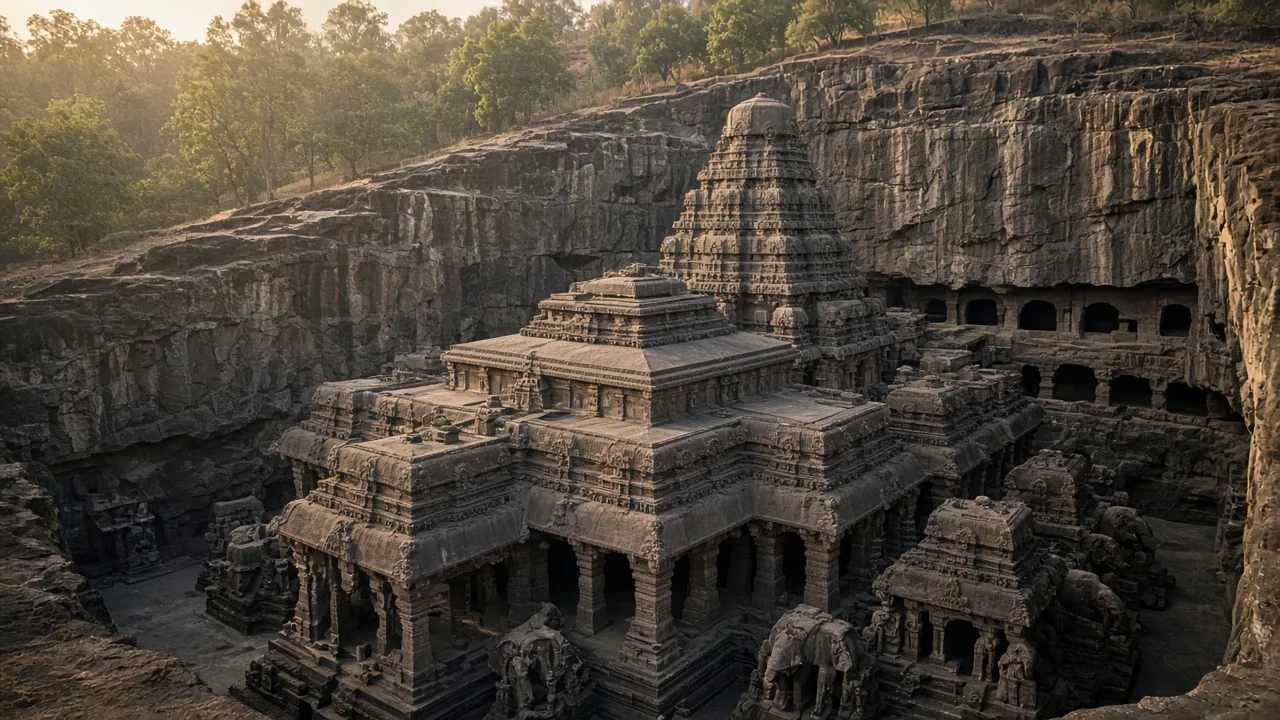
Ellora, near the village of Verul, is younger. The ASI dates its caves from roughly the 6th to 7th century CE through to the 11th to 12th century. Of nearly 100 caves in the hills, 34 are the main visited group: Buddhist caves (1 to 12), Hindu caves (13 to 29) and Jain caves (30 to 34). Its centrepiece, the Kailasa Temple (Cave 16), is generally attributed to the Rashtrakuta king Krishna I in the 8th century and is described by the ASI as the largest single monolithic excavation in the world.
What to see at Ajanta
- Cave 1: Home to the celebrated Padmapani and Vajrapani bodhisattva paintings, some of the finest surviving examples of ancient Indian painting.
- Cave 2: Ceiling patterns and murals telling stories from the Jatakas, tales of the Buddha's previous lives.
- Caves 9 and 10: Among the earliest chaitya halls, with simple, powerful lines.
- Cave 17: Perhaps the richest gallery of narrative murals, with courtly scenes, animals and processions.
- Cave 19 and Cave 26: Elaborately carved prayer halls; Cave 26 has a large reclining Buddha depicting the parinirvana.
- Viewpoint: A trail leads to a lookout across the gorge for the classic horseshoe view of the complex.
What to see at Ellora
- Kailasa Temple (Cave 16): Carved from the top down out of a single rock, it includes a full temple with courtyards, life-size elephants and towers. Walk the upper ledges for a view down into the structure.
- Cave 10 (Vishwakarma): A Buddhist chaitya with a ribbed ceiling that imitates timber beams.
- Cave 12 (Teen Tal): A three-storey Buddhist monastery.
- Cave 21 (Rameshwar) and Cave 29 (Dhumar Lena): Superb Hindu sculpture, including river goddesses and scenes from Shiva's life.
- Cave 32 (Indra Sabha): The finest of the Jain caves, with delicate carving on two levels.
The Grishneshwar Jyotirlinga temple is close to Ellora, and Daulatabad (Devagiri) Fort lies on the road back to the city.
Best time to visit
The ASI lists October to March as the best season. Summer temperatures can reach around 40°C. The monsoon (roughly July to September) turns the Ajanta gorge lush, and the waterfall at its head often flows, but paths can be slippery. Avoid long weekends and holidays if you can, as both sites get crowded.
How to get there
- Base city: Chhatrapati Sambhajinagar, which has an airport and a railway station. Ellora is about 30 km away; Ajanta is roughly 100 km, around two and a half to three hours by road.
- From Mumbai: Short flights, or trains and overnight buses of roughly six to eight hours. By road it is about 330 km.
- From Pune: Around 230 to 240 km by road, or about five to six hours.
- From Delhi, Hyderabad and Bengaluru: Direct flights to Chhatrapati Sambhajinagar have operated on some routes; otherwise connect via Mumbai. Schedules change, so check current options.
- Ajanta alternative: Jalgaon railway station, roughly 60 km from Ajanta, is handy if you are coming on a north-south rail route.
- At Ajanta: Private vehicles stop at the visitor centre near the Fardapur T-point, from where shuttle buses run to the caves.
Tickets and timings for Indian travellers
ASI listings show similar fees at both sites: about Rs 40 for Indian citizens and SAARC and BIMSTEC nationals (around Rs 35 online), and about Rs 600 for other foreign visitors (around Rs 550 online). Children below 15 enter free. There are separate small charges for the Ajanta shuttle bus.
The most important detail is the weekly closure: Ajanta is closed on Mondays and Ellora on Tuesdays. Ajanta is open roughly 9 am to 5 pm, and Ellora from sunrise to sunset. Treat all figures as approximate, and check the ASI website before travel.
Practical tips
- Plan at least two days: one for each site. Trying to do both in a day means rushing Ajanta's paintings.
- Book tickets online where possible to save queuing.
- Flash photography is not allowed inside the painted caves, and light inside is kept low to protect the murals. Let your eyes adjust and take your time.
- Wear shoes you can slip off easily, as footwear has to be removed in some caves.
- At Ellora, see Kailasa early in the morning before the tour groups arrive, then cover the Buddhist and Jain caves.
- Carry water and a small torch; options for food near the caves are limited.
- Hire a licensed guide at Ajanta. The murals are full of stories that are easy to miss without one.