Owning an electric car is easiest when it charges where it sleeps. Plug in overnight, wake up to a full battery, and public chargers become something you only need on road trips. Getting there takes a little planning: choosing the right charger, checking your electrical supply and, if you live in an apartment, getting permission from your society or building manager.
Know your charging options
Home charging is AC charging, and its speed is limited by two things: the power your supply and charger can deliver, and the maximum your car's onboard charger accepts. A car with a 7.2 kW onboard charger won't charge faster on an 11 kW wall box.
| Charger type | Typical power | Supply needed | Approx. range added per hour | 0–100% on a 40 kWh battery |
|---|---|---|---|---|
| Portable charger (15 A socket) | 2.5–3.3 kW | Single-phase, dedicated socket | 15–25 km | 12–16 hours |
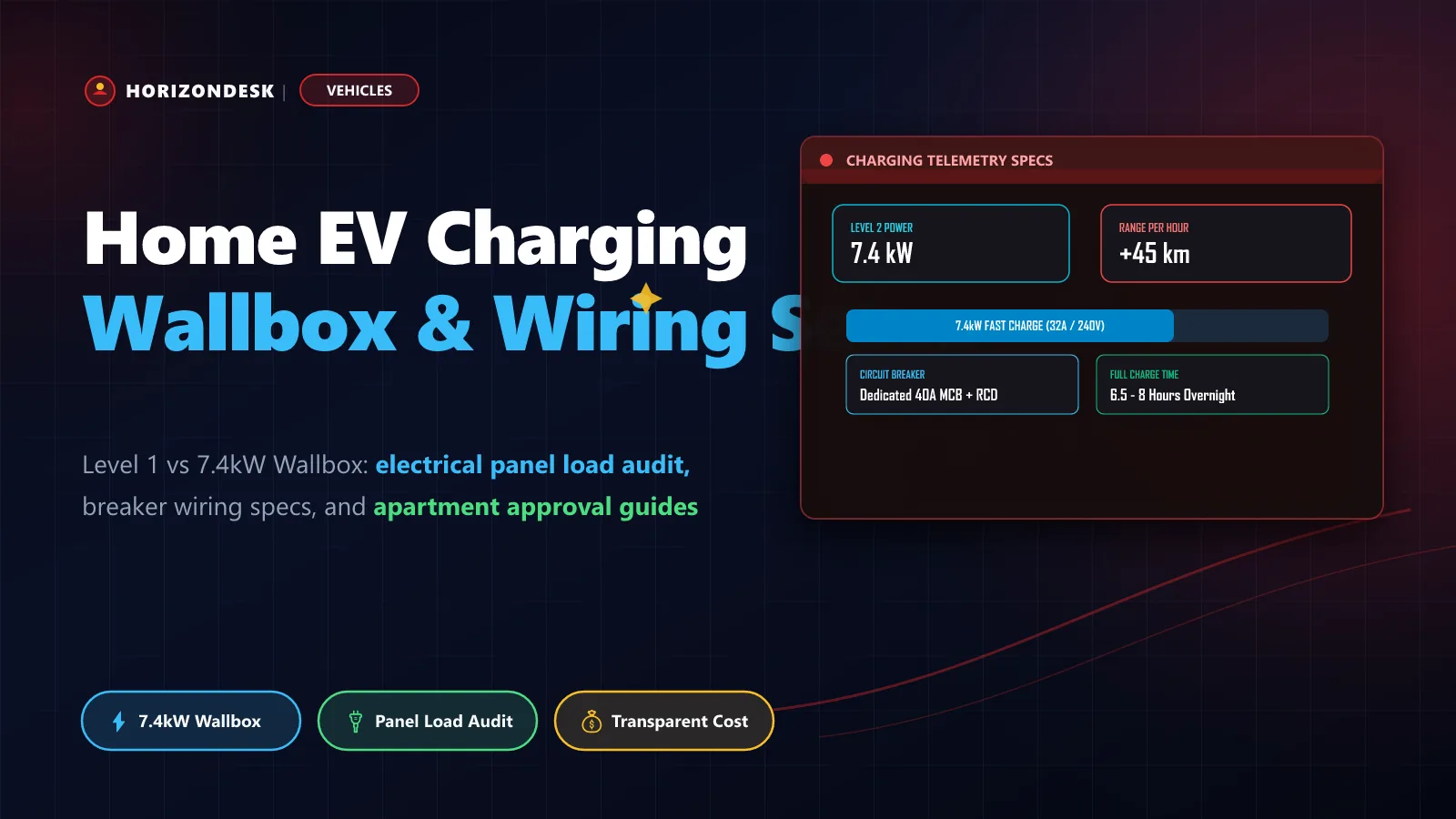
| Wall box, single-phase | 7–7.4 kW | Single-phase, dedicated circuit | 40–50 km | 6–7 hours |
| Wall box, three-phase | 11 kW | Three-phase supply | 65–75 km | About 4 hours (if the car supports it) |
Range figures assume roughly 6–7 km per kWh and include some charging losses. In North America the equivalents are Level 1 (a standard 120 V outlet, very slow) and Level 2 (a 240 V circuit, similar to the wall boxes above).
For most people driving 30–60 km a day, even a portable charger replaces a day's driving overnight. A wall box is worth it if you drive more, share one car between several drivers, or want the flexibility of a quick top-up in the evening.
Check your electrical supply first
An EV draws high current for hours at a time — a very different load from a kettle or a microwave. Before buying anything, have a licensed electrician check:
- Sanctioned load. A 7.4 kW charger alongside air conditioners and a geyser can exceed your connection's sanctioned load. You may need to apply to your electricity provider for an increase.
- A dedicated circuit from the distribution board, with cable sized for continuous load and its own MCB.
- Residual current protection. EV chargers need an RCD that handles DC leakage — either a Type B RCD, or a charger with built-in 6 mA DC fault detection used with a Type A RCD.
- Proper earthing, tested and documented. Poor earthing is a common reason chargers refuse to start or trip repeatedly.
Charging in an apartment
Apartment residents face extra steps. You'll typically need written permission from the housing society or building management, a way to route cable from your own meter to your parking spot, and agreement on who pays for installation. Many cities and states now actively encourage charging in residential buildings, and some societies install shared metered chargers. Start the conversation early; approvals can take weeks.
The best charger is the one you can plug into every night without thinking about it.
What it costs
As a rough illustration in India, a portable charger is often included with the car or costs ₹15,000–₹25,000, while a branded 7.4 kW wall box typically costs ₹40,000–₹70,000 plus installation. Wiring costs depend heavily on the distance from your meter to the parking spot and whether a load upgrade is needed. Some carmakers bundle a wall box and basic installation with the purchase, so ask before you buy.
Running costs are where home charging shines. At an illustrative ₹8 per kWh, adding 100 km of range costs roughly ₹115–₹135. Where your electricity board offers a separate EV tariff or cheaper night-time rates, it can be even lower.
Smart habits for daily charging
- Schedule charging overnight using the car's app or the charger's timer, especially if you have time-of-day pricing.
- Follow your manufacturer's advice on charge limits. Many recommend an everyday limit of around 80% for NMC batteries, while LFP batteries are often happy being charged to 100% regularly.
- Inspect the cable and plug every few weeks for cuts, scorch marks or loose connections.
- Protect outdoor installations from direct rain with a covered mount, even if the charger is weather-rated.
Set it up properly once, and home charging becomes the least eventful part of owning an EV — which is exactly how it should be.