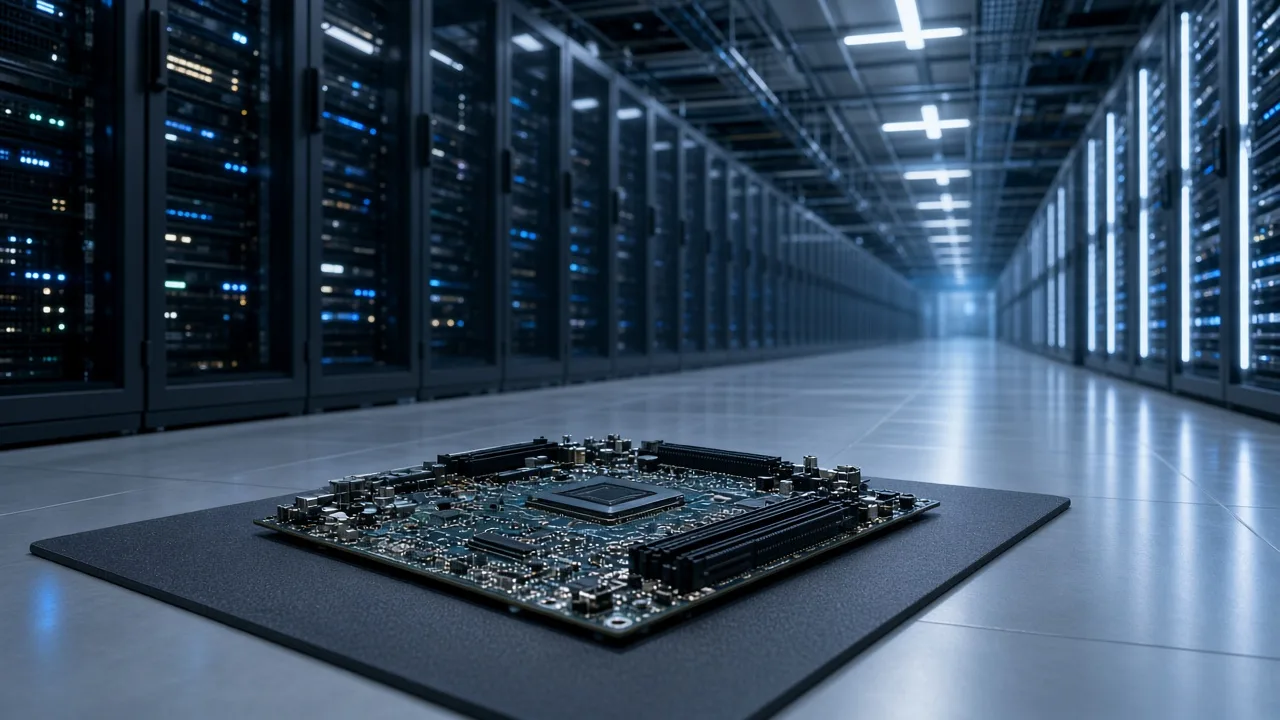
Every time you ask an AI assistant a question, a chip in a data centre somewhere does the work. Multiply that by hundreds of millions of people and the bill for electricity, hardware and cooling becomes one of the biggest costs in technology. On 12 October 2026, Microsoft made its latest move to bring that bill down when it announced Maia 300, the third generation of its custom AI chip.
It's a story about silicon, but it affects anyone who uses AI at work or at home. Here's what Microsoft announced, why more tech giants are designing their own chips and what to watch for next.
What Maia 300 is
Maia 300 is built for inference, the stage where a trained AI model actually answers your requests. That's different from training, the enormous one-off effort of building a model in the first place. Inference happens every second of every day, so efficiency gains add up quickly.
Microsoft says Maia 300 will become the primary AI inference system for its products and services, and that it plans to expand its Azure Maia system to multi-gigawatt deployments starting in 2027. The company's main claims are:
- 40% more tokens per megawatt. Tokens are the small chunks of text a model reads and writes. More tokens per unit of power means more AI work from the same electricity.
- Up to seven times the token throughput of Maia 200 at rack scale inside Microsoft data centres.
- Designed for newer workloads, including long-context reasoning, fast conversational responses and multi-step agent tasks that run for a long time.
Technology site Notebookcheck reported that the chip carries 288 GB of HBM4 high-bandwidth memory with 18 TB/s of bandwidth. Large amounts of fast memory matter because modern AI models, especially ones working with long documents or long conversations, need to keep a lot of information close at hand.
Why tech giants are designing their own chips
For years, one supplier's graphics processors have dominated AI computing. They're powerful and flexible, but they're also expensive and often hard to get. Designing your own chip offers several advantages.
Cost control
A company running AI at Microsoft's scale can save huge sums by building hardware tuned to its own workloads rather than paying for general-purpose capabilities it doesn't need.
Power efficiency
Electricity has become a real constraint on AI growth. New data centres need grid connections that can take years to secure. Getting 40% more output from each megawatt, if Microsoft's claim holds, is like finding extra capacity without building a new power plant.
Supply independence
Owning the design reduces reliance on any single vendor's roadmap, pricing and production limits. That's why commentators framed Maia 300 as a way for Microsoft to become less dependent on outside GPUs.
The money behind the AI build-out
The announcement comes as investors and regulators are taking a harder look at the economics of AI infrastructure. In its latest Global Financial Stability Report, the International Monetary Fund flagged a possible AI share-price correction as a key risk, AI Affairs reported. A separate IMF study pointed to chip accounting as a pressure point. Major cloud providers generally assume their equipment lasts about seven years, and the study found that cutting that assumption to three years could reduce their operating margins by more than nine percentage points.
That's why efficiency matters so much. The cheaper each AI answer becomes, the easier it is for the companies spending heavily on AI to earn back their investment.
The AI race is no longer just about who has the smartest model. It's also about who can run that model most cheaply, reliably and at the largest scale.
What it means for everyday users
You won't buy a Maia chip or see one, but you may feel its effects. Microsoft says Maia 300 will support more efficient coding in GitHub, more flexible model deployment through Microsoft Foundry and faster interactions in Copilot, Teams and Dragon Copilot. In practice, cheaper inference tends to show up as:
- Faster responses, particularly on long documents and complex requests
- More generous usage limits on AI features bundled into software you already pay for
- AI features spreading into more everyday tools as the cost of offering them falls
A quick note on inference versus training
Training is what made headlines in the early years of the AI boom: huge clusters running for months to build a single model. Inference is the ongoing cost of putting that model to work. As more people rely on AI every day, and as agents run long tasks that keep a chip busy for minutes or hours, inference becomes the larger and more lasting expense. That shift explains why Microsoft built Maia 300 specifically for inference rather than for training.
What to watch next
Keep a few questions in mind as 2027 approaches. Will independent testing confirm Microsoft's efficiency figures once the chip is running at scale? Will savings be passed on to customers through pricing, or kept as margin? And how will rivals respond? The other big cloud companies have their own custom chip programmes, and each new generation pushes the others to keep up.
The takeaway
Maia 300 is a reminder that AI's future depends as much on unglamorous engineering as on clever models. Chips that do more work with less power make AI cheaper to offer, easier to scale and less of a strain on electricity grids. If Microsoft delivers on its claims, the benefits will show up quietly, in quicker replies and AI features that turn up in more places.