Walk into a showroom today and you'll likely be choosing between two very different kinds of efficient car: a full electric vehicle that never visits a fuel pump, and a strong hybrid that pairs a petrol engine with a battery and electric motor. The EV usually costs more upfront and much less to run. The hybrid is the reverse. Which is cheaper depends on how you drive — so let's actually do the maths.
The assumptions
We'll compare two illustrative compact SUVs of similar size over five years. Prices and costs are examples meant to show the method; plug in the figures for the cars and city you're actually considering.
- Distance: 15,000 km a year, so 75,000 km in total.
- EV: ₹18 lakh on-road, about 7 km per kWh, charged mostly at home at ₹8 per kWh.
- Strong hybrid: ₹17 lakh on-road, about 20 km per litre in mixed driving, petrol at ₹105 per litre.
- Resale: an assumed 44% of purchase price for the EV and 53% for the hybrid after five years. Used-EV values are still the least certain part of this calculation.
Five-year cost comparison
| Cost item (5 years) | Electric SUV | Strong hybrid SUV |
|---|---|---|
| On-road price | ₹18,00,000 | ₹17,00,000 |
| Energy (75,000 km) | ₹86,000 | ₹3,94,000 |
| Scheduled servicing | ₹40,000 | ₹80,000 |
| Insurance | ₹3,20,000 | ₹2,80,000 |
| Tyres | ₹45,000 | ₹35,000 |
| Less: estimated resale value | −₹8,00,000 | −₹9,00,000 |
| Net cost of ownership | ₹14,91,000 | ₹15,89,000 |
| Cost per km | ≈ ₹19.9 | ≈ ₹21.2 |
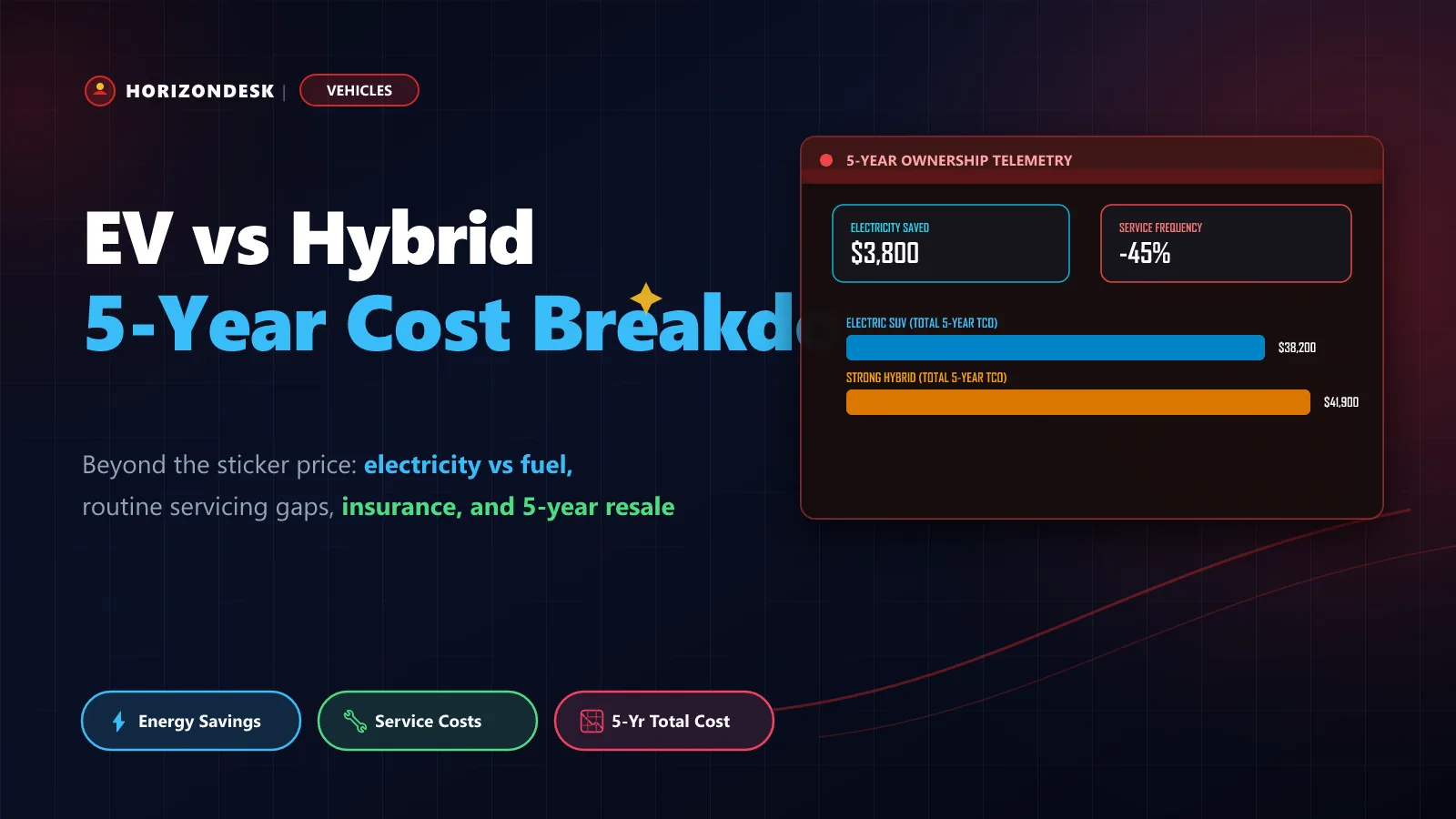
In this scenario the EV comes out around ₹98,000 ahead over five years. The energy saving is huge — roughly ₹1.15 per km against ₹5.25 — but higher insurance, faster tyre wear and weaker expected resale claw a lot of it back.
Where the EV pulls ahead
- High mileage. Every extra kilometre widens the gap. At 25,000 km a year the EV's lead grows to well over ₹2 lakh in this example.
- Cheap home charging. Some electricity boards offer EV-specific or time-of-day tariffs that cut charging costs further.
- Lower maintenance. No oil changes, no spark plugs, no clutch, and regenerative braking means brake pads last much longer.
- Incentives. Road-tax waivers and registration benefits, where available in your state, can tilt the purchase price significantly.
Where the hybrid wins
Low annual mileage
Drop to 8,000 km a year and rerun the numbers: the EV's energy saving shrinks to around ₹1.6 lakh over five years, and the hybrid edges ahead by roughly ₹40,000 once insurance and resale are included. If your car mostly sits in the parking lot, the EV's premium takes longer to recover.
No home charging
Relying on public DC fast chargers at ₹18–25 per kWh makes the EV's energy cost per kilometre two to three times higher. In our example, paying ₹20 per kWh for every charge is enough to flip the result: the hybrid comes out around ₹30,000 ahead. Without a home or workplace charger, the EV's cost case largely disappears.
Frequent long highway trips
A hybrid refuels in five minutes anywhere. Fast-charging networks along major highways have improved a lot, but planning stops still adds time to long journeys, especially in peak travel seasons.
An EV saves money per kilometre. Whether it saves you money depends on how many kilometres you drive.
The verdict
For a driver covering 12,000 km or more a year, with a parking spot where a charger can be installed, the EV is likely to be the cheaper car over five years — and it's quieter and smoother to drive. For lower-mileage drivers, those who would depend on public fast chargers, or anyone who regularly covers long distances in areas with patchy charging, a strong hybrid remains an excellent, low-risk choice.
The same logic applies outside India. In the US, compare your local electricity rate per kWh with gasoline per gallon, and swap in your own insurance quotes. The method doesn't change: add up every cost, subtract resale, and divide by the kilometres or miles you'll really drive.