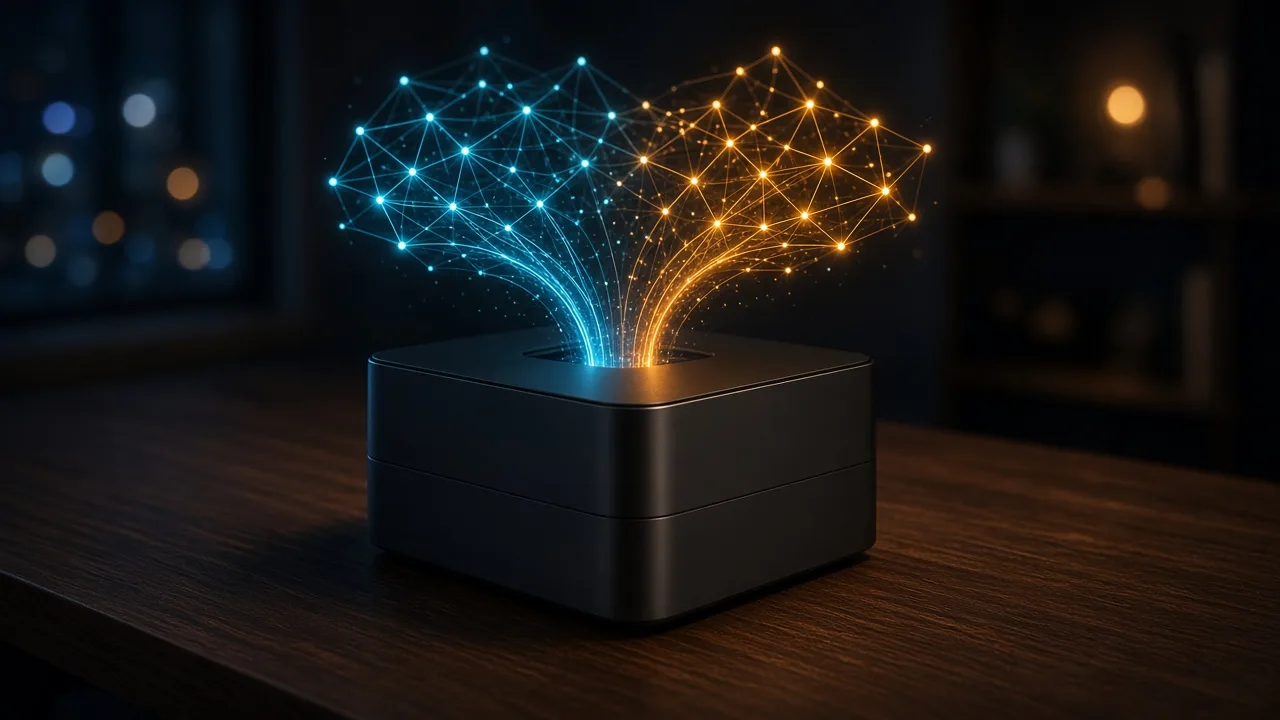
AMD's "Halo" name has stopped being only a nickname for a chip. In 2026, Ryzen AI Halo is the name of a real product: a small desktop developer platform made to run large AI models on your own desk instead of renting time in the cloud. On October 12, 2026, AMD announced the second version, built on the new Ryzen AI Max+ PRO 495 processor with up to 192GB of unified memory. Here is what Ryzen Halo means today, what changed, and why it matters.
From Strix Halo to a product called Halo
"Strix Halo" was the codename enthusiasts used for AMD's Ryzen AI Max family. These are large APUs that put Zen 5 CPU cores, a strong RDNA 3.5 integrated GPU and an XDNA NPU in one package, all sharing a single pool of LPDDR5x memory. In 2026 AMD built a branded system around that silicon. The first Ryzen AI Halo Developer Platform uses the Ryzen AI Max+ 395 with 128GB of unified memory. AMD and Micro Center say it can run local models of up to 200 billion parameters.
AMD said on July 6, 2026 that the system was shipping, and named Micro Center its first global launch partner. Micro Center's footnotes list the 128GB Ryzen AI Halo at a retail price of $3,999. AMD's own performance comparisons put NVIDIA's DGX Spark at $4,699.
The new flagship: Ryzen AI Max+ PRO 495
The October 12 announcement adds a higher tier. AMD says the new Ryzen AI Halo offers:
- Up to 16 "Zen 5" CPU cores
- 40 RDNA 3.5 GPU compute units
- An NPU rated at up to 55 TOPS
- Up to 192GB of LPDDR5x unified memory, with up to 160GB assignable to the GPU as VRAM
AMD's user guide also lists the memory differences between the two models. The 395 system runs its memory at 8000 MT/s with 256 GB/s of bandwidth. The 495 system runs at 8533 MT/s with 273 GB/s. Both models come with a 2TB M.2 SSD, 10 Gbps Ethernet, Wi-Fi 7, Bluetooth 5.4, HDMI 2.1b and several USB-C ports. Both support Linux or Windows 11.
Memory capacity is the headline. AMD says the 192GB model can run language models with 300 billion parameters or more at 4-bit quantization. It can also run several large agents at the same time, each with its own KV cache. This works because the CPU, GPU and NPU all read from one high-bandwidth memory pool. Data doesn't have to be split between system RAM and a separate graphics card.
Built for agents, not just chatbots
AMD's pitch is about where AI is going. The company argues that AI is moving from assistants that answer prompts to agents that read files, call tools, run parallel processes and check their own output before handing over a finished result. In that kind of work, tokens per second is only part of the picture. The CPU handles orchestration, the GPU and NPU speed up inference, and the large memory keeps models and working data loaded.
That framing explains why AMD keeps comparing Halo with other compact "AI box" machines rather than gaming PCs. The question isn't frame rates. It's whether one quiet desktop can keep a 100-billion-plus parameter model and a full agent toolchain running together.
Creative AI and the benchmarks
AMD also wants Halo to be seen as a generative media machine. Its September 2026 tests ran ComfyUI workloads that included FLUX.2, Qwen Image, Z Image Turbo, LTX, ACE-Step and Microsoft Trellis for 3D. AMD says the Max+ PRO 495 beat an Intel Core Ultra X9 388H (Panther Lake) system across the tested workloads. It also says the 495 beat a MacBook Pro with an Apple M5 Pro, and that several workloads didn't run at all on the Apple machine.
These are vendor benchmarks. AMD's own footnotes say the 495 system had 192GB of memory with Variable Graphics Memory set to 128GB, while the Intel and Apple systems had 64GB. Treat the results as a sign of what large memory capacity allows, not as an independent head-to-head test.
Software: the less flashy part that matters
Hardware alone has never been AMD's problem in AI. Software has. Halo addresses this directly. Every unit ships with the AMD Ryzen AI Developer Center, a hub for tools, platform controls and updates. It also includes preloaded apps and models, plus AMD AI Playbooks, which are guided, validated walkthroughs of common AI workflows. AMD says it tests ROCm, drivers, frameworks, apps and models together as a "Best-Known Configuration." Developers can experiment freely and then restore that validated state from the Developer Center if something breaks.
The pitch is that you can power the machine on and reach your first token in minutes. If it holds up in practice, that could matter more than any spec on this list. ROCm support for consumer hardware has long been the main complaint about building on AMD.
Availability and what's next
AMD says the Linux-based Ryzen AI Halo with the Max+ PRO 495 will be sold through Micro Center. The announcement now links to ordering. AMD hasn't published a price for the 192GB model in the materials we reviewed. Windows-based Ryzen AI Halo systems with the 495 are listed as "coming soon," together with something AMD calls Windows Project Zenith. The 128GB Max+ 395 model is still available.
The bottom line
Ryzen AI Halo is AMD's clearest sign yet that it wants to own the local AI workstation category. The case rests on huge unified memory in a small box, a software stack that is finally being curated, and pricing below NVIDIA's DGX Spark, at least on the 128GB model. The 192GB Max+ PRO 495 raises the ceiling to 300B-class models. Independent reviews of real-world speed are still to come, as is the price of the new model. But for developers who want big models kept private and on-premises, "Halo" now refers to a complete product, not just a codename.
Sources
- AMD Blog, "Meet the Next AMD Ryzen AI Halo" (Oct 12, 2026): https://www.amd.com/en/blogs/2026/meet-the-next-amd-ryzen-ai-halo.html
- AMD Blog, "AMD Ryzen AI Halo Now Available at Micro Center" (Jul 6, 2026): https://www.amd.com/en/blogs/2026/amd-ryzen-ai-halo-now-available-at-micro-center.html
- AMD, "AMD Ryzen AI Halo for AI Developers": https://www.amd.com/en/products/processors/desktops/ryzen/ryzen-ai-halo.html
- AMD AI Playbooks, "AMD Ryzen AI Halo User Guide": https://developer.amd.com/playbooks/user-guide/
- Micro Center, "AMD Ryzen AI Halo": https://www.microcenter.com/site/content/amd-ryzen-ai-halo.aspx